
A closed book can look finished
Imagine closing an article whose margins are full. There are underlined definitions, neat stars beside important passages, and a final page reached before dinner. Asked what the author argues, the reader can repeat several phrases. Asked why two closely related ideas are different, the reader becomes less certain. The visible work is real, but it is not quite the work the question requires.
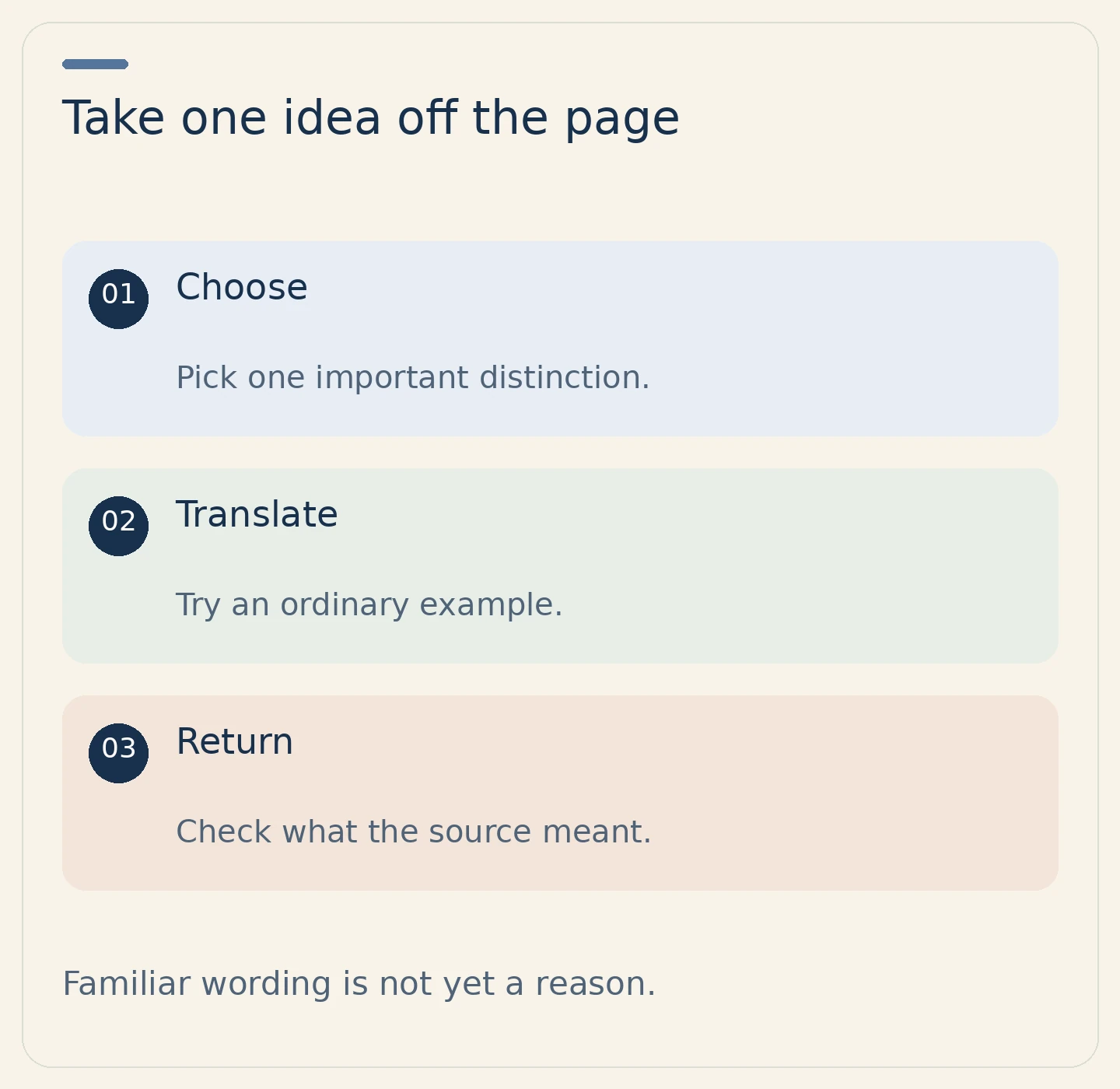
There is nothing fraudulent about marking a text. Marks can preserve a useful route back into it. Trouble begins when they become certificates of understanding. An underline tells us that a sentence attracted attention. It does not tell us whether the reader can reconstruct its reason, identify its limits, or notice when the same words are being used differently in another setting.
Let one distinction travel
Consider a hypothetical article distinguishing access from participation. Recognizing those words in the text is easier than explaining their difference without them. A reader might try the example of a community meeting: a person can enter the room but may have no practical chance to contribute before decisions are made. The example gives the distinction something to do beyond its original paragraph.
Yet it also introduces risks. Perhaps the source uses access to include meaningful opportunities to speak. In that case, the example has not clarified the author's distinction; it has replaced it with the reader's preferred version. This is why the return journey matters. Moving into an everyday setting is an experiment, not permission to treat a convenient analogy as the source's actual claim.
The return is part of the reading
A small practice is to choose one distinction after a section, close the text, and describe a fresh case in a few sentences. Then reopen the relevant passage. Where does the explanation fit, and where does it stretch? The point is not to reproduce polished terminology from memory. It is to make a possible misunderstanding visible while the source is still available to correct it.
The correction may be surprisingly narrow. One word needs changing, or a condition needs adding. Perhaps the everyday example concerns fairness while the text concerns practical opportunity. That difference is worth retaining rather than smoothing away. The reader now has a record not merely of what sounded important, but of how their first interpretation departed from the argument they were trying to understand.
The new example should remain visibly separate from notes on the source. Otherwise a useful act of interpretation can later be remembered as something the author actually wrote. Keeping that distinction clear preserves both the freedom to experiment and the ability to check whose explanation is being used.
Not every page needs the same treatment
Reading has purposes other than deep reconstruction. Sometimes a person needs to locate a date, decide whether an article is relevant, or get a broad orientation before reading closely. Treating every paragraph as an examination can make reading unnecessarily heavy. A useful distinction is between moving through a text for a purpose and assuming that movement has achieved every possible purpose.
Some material also resists an ordinary analogy. A technical definition may depend on relations that an everyday scene distorts. Then a smaller formal example, a diagram, or a careful contrast may serve better. The test is not whether the explanation sounds friendly. It is whether the relevant relationship survives. Plain examples are tools for checking understanding, not a demand that every difficult idea become familiar immediately.
What the margins cannot show alone
After the imagined reader returns to the article, the original marks need not be discarded. One additional note might change their function: the meeting example works only if entering and contributing are treated separately. Now the underline has an explanation attached. The page records an encounter between the author's distinction and the reader's attempt, rather than a collection of sentences judged worthy of fluorescent ink.
That encounter gives finishing a different meaning. Reaching the last page closes a reading session; being able to rebuild one reason changes what can be carried out of it. These achievements can occur together, but neither guarantees the other. A shorter stretch read with a tested distinction may leave a more usable understanding than a longer stretch whose language remains recognizable only while the book is open.