Why AI Detectors Flag Human Essays & How to Protect Your Work
Learn why AI detectors misflag structured ESL essays via perplexity and burstiness bias, how to document authentic authorship, and how to vary prose ethically before submission.

Key Takeaways: AI detectors do not measure truth or effort—they score statistical predictability (perplexity) and sentence-rhythm variation (burstiness). Because disciplined non-native English (ESL) prose relies on clear academic templates and steady sentence lengths, it frequently triggers false positives. Protect yourself by varying sentence cadence without sacrificing clarity, keeping timestamped revision records, and running responsible pre-checks before your university's official submission.
You spend two weeks outlining a literature review, verifying every citation, and polishing your English transitions. Then you run a pre-check—and a dashboard flashes 44% AI-Generated. You did not copy a single line from a chatbot. Why would an algorithm mistake careful student writing for machine output?
Why Structured ESL Prose Triggers False Positives
AI detectors do not "recognize" human thought. Instead, they ask a narrow statistical question: *How likely would a language model be to pick these exact words in this exact order?* Two metrics drive that score:
- Perplexity measures how predictable your word choices are. Low perplexity means every next word feels statistically "expected" to a language model.
- Burstiness measures how much sentence lengths and grammatical rhythms fluctuate from one line to the next.
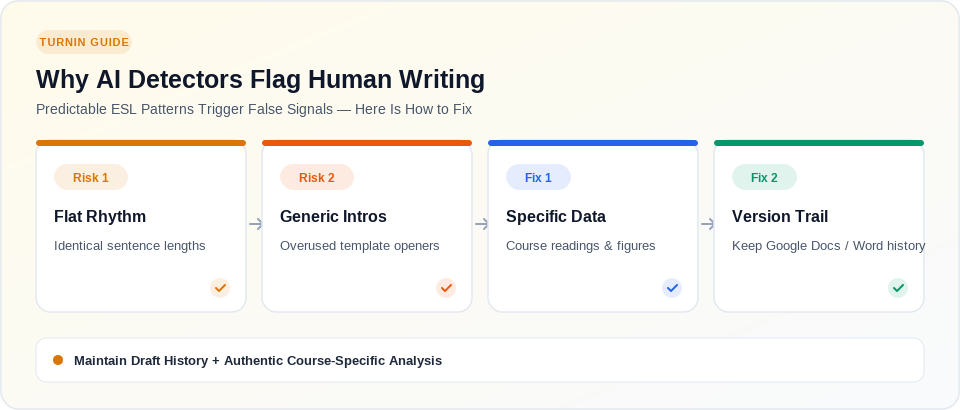
Here is the trap for multilingual students. In IELTS, TOEFL, and university writing workshops, you are rewarded for disciplined, predictable structure: a clean topic sentence, a standard transition (*"Furthermore," "In addition," "Consequently"*), a 17-to-22-word explanation, and a cautious academic hedge (*"It can be argued that..."*).
To a human professor, that control signals strong preparation. To a statistical detector, low perplexity paired with flat burstiness closely resembles an LLM generating median-probability academic English. Native writers are more likely to drop in idioms, abrupt short claims, or varied clauses that spike perplexity—even when their argument is less organized than yours.
Perplexity, Burstiness, and Detector Blind Spots Compared
When students ask advisors why a human essay scored high, the pattern almost always traces back to five mechanical habits.
| Writing Signal | Common ESL Pattern | How Detectors Read It | Ethical Way to Address It |
|---|---|---|---|
| Formulaic Transitions | Starting consecutive lines with *"Moreover," "Additionally,"* or *"In conclusion"* | High token predictability lowers perplexity across sentences | Link ideas through key nouns (*"That funding gap..."*) instead of generic adverbs |
| Uniform Sentence Length | Repeating 16–22 word Subject–Verb–Object sentences | Flat cadence scores as low burstiness, typical of unedited LLM text | Pair a crisp 7–10 word claim with a 25–30 word evidence-backed analysis |
| Safe Academic Hedges | Using filler frames like *"plays an important role"* or *"it is worth noting"* | Overrepresented in both L2 textbooks and LLM training corpora | Replace vague frames with exact verbs (*"accelerates," "restricts," "distorts"*) |
| Global Grammar Rewrites | Accepting "Rewrite for fluency" suggestions from grammar or translation apps | Whole-clause smoothing erases personal syntax and mimics AI phrasing | Restrict tools to spelling, articles, and prepositions; draft sentences yourself |
| Abstract Summaries | Describing broad trends without naming dates, studies, or sample sizes | Generic synthesis mirrors how chatbots summarize unfamiliar topics | Anchor claims with exact readings, page numbers, and empirical thresholds |
Notice what this table never recommends: breaking grammar rules or injecting strange synonyms to "fool" an algorithm. Mangling clarity hurts your grade far more than a noisy pre-check score.
Before-and-After Edits That Raise Burstiness Without Hurting Clarity
The safest way to reduce false-positive risk is to make your prose more specific and rhythmically natural—the exact qualities human graders reward. Compare these two versions of a policy paragraph:
Before: Uniform, High-Risk ESL Pattern
Carbon pricing plays an important role in reducing industrial emissions. Furthermore, many governments have implemented carbon taxes in recent years. Consequently, manufacturing firms are encouraged to adopt cleaner technologies. In addition, these policies can generate revenue for public green infrastructure. However, small enterprises often face high compliance costs during the transition period.
Every sentence sits between 11 and 15 words, every transition opens the line, and the verbs stay generic. Detectors frequently flag blocks like this purely for flat rhythm.
After: Authentic, Varied Academic Voice
Carbon pricing cuts industrial emissions fastest when regulators pair predictable fees with targeted transition aid. Across twelve European municipalities studied between 2018 and 2023, carbon taxes pushed mid-sized manufacturers to retrofit boilers within two budget cycles—a shift that also funded local transit upgrades. Yet that same compliance burden hits small workshops hard. Without upfront rebates, cash-strapped firms delay equipment upgrades rather than absorb the tax.
The word count is nearly identical and the grammar stays spotless. Now, however, sentence lengths swing from 9 words to 28 words, concrete nouns (*"mid-sized manufacturers," "retrofit boilers," "upfront rebates"*) replace filler, and the logical link (*"Yet that same compliance burden..."*) grows directly from the prior claim.
As a realistic benchmark, never chase a mythical 0% AI score. Scattered single-digit flags (0%–12%) often reflect standard definitions or citations, whereas sustained multi-paragraph highlights warrant revision. Remember that Turnin is an independent self-review platform, never official Turnitin, and your university's official screening system always prevails.

Five-Step Workflow to Document Authorship and Revise Ethically
Build this five-step routine into every assignment so you catch stylistic false-positive triggers early and hold clear proof of authorship:
- Preserve a timestamped paper trail from outline to final draft. Write in Google Docs or Microsoft Word with Version History enabled, keeping your bullet outline, PDF notes, and reference library in one folder. Timestamped revision logs settle almost any false-positive question.
- Run a diagnostic pre-check before touching your wording. Upload your draft for an AI detection pre-check on Turnin alongside a similarity check to separate genuine stylistic stiffness from quoted source overlap.
- Read the report like an editor, not an alarm bell. Compare highlighted blocks against a sample Turnin diagnostic report to see whether flags stem from isolated transitions or uniform multi-sentence blocks.
- Revise for specificity and cadence—skip blind "humanizer" spinners. Automated spinners swap accurate terms for awkward synonyms and damage academic tone. Instead, vary sentence openings yourself, add course-specific data, and test targeted phrasing adjustments in Turnin's ethical revision workspace while ensuring every claim remains 100% yours.
- Archive your clean submission copy and process notes. Export your final file and revision history before uploading to your course portal, keeping in mind that advisory pre-checks support responsible preparation while your university's official Turnitin report remains the binding record.
Frequently Asked Questions About AI False Positives
Does a 25% or 35% AI score automatically prove academic misconduct?
No. Responsible universities treat AI percentages as screening signals, not standalone proof. Instructors review highlighted passages alongside your writing style, citation accuracy, and authorship records such as version history, reading notes, and follow-up discussions.
Can grammar checkers or translation tools push my human essay into the flagged zone?
Yes. Checking spelling or prepositions rarely creates risk, but clicking "Rewrite for fluency" or pasting paragraphs through an AI translator replaces your natural syntax with low-perplexity phrasing that detectors frequently flag.
If Turnin shows a low AI score, will my university's official report match it exactly?
Not necessarily. Different detection engines use different models, thresholds, and reference databases. Turnin helps you spot rigid phrasing and documentation gaps ethically beforehand, while your university's official Turnitin or institutional system always makes the final determination.