APA 7th Edition Citations: In-Text, DOIs & Common Mistakes
Master APA 7th edition in-text citations and reference lists with clear examples for 1 to 3+ authors, DOIs, websites, and secondary sources—plus the formatting traps graders catch first.

Key Takeaways: APA 7th edition simplifies in-text citations by usinget al.from the very first mention for three or more authors, standardizes DOIs as clickablehttps://doi.org/links, and drops "Retrieved from" for stable webpages. Catching small formatting traps—like&vs.and, sentence case in titles, and hanging indents—protects your grade before submission.
Ask any university writing-center advisor what costs strong students the easiest marks on a research paper, and the answer is rarely the thesis. It is almost always the reference list. You can spend three weeks analyzing peer-reviewed studies and still lose five to ten percent because an ampersand wandered into a narrative sentence, or a stray period broke a DOI hyperlink.
APA 7th edition—the current standard across psychology, education, nursing, business, and the social sciences—actually streamlined many older rules. Once you understand the underlying pattern, citing accurately becomes mechanical in the best way: fast, predictable, and verifiable.
In-Text Citations: Parenthetical vs. Narrative Rules
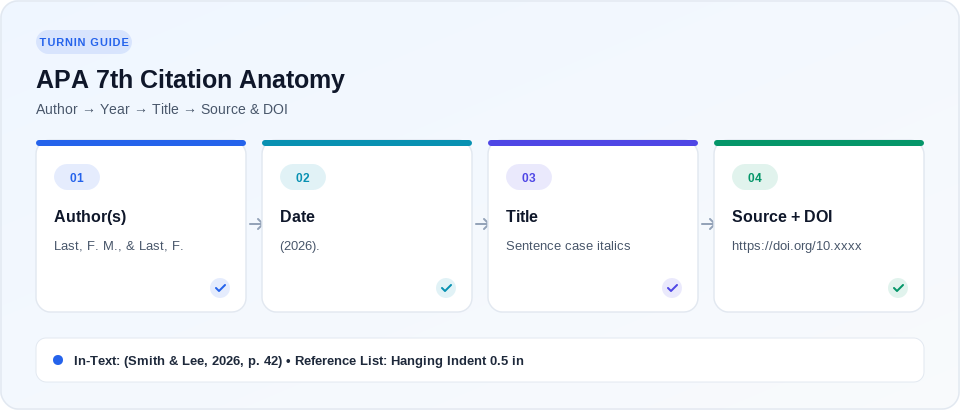
Every APA 7th in-text citation requires two core pieces of information: the author's surname (or organization name) and the publication year. Add a page or paragraph locator when quoting directly or pointing to a specific table or argument.
Where students most often slip is mixing up parenthetical and narrative syntax:
- One author: Parenthetical
(Alvarez, 2024)vs. narrativeAlvarez (2024) demonstrated... - Two authors: Use an ampersand (`&`) inside parentheses—
(Chen & Patel, 2023)—but spell out `and` in running prose:Chen and Patel (2023) argued... - Three or more authors: APA 7th eliminated the old rule requiring you to list up to five authors on first mention. Now, use `et al.` from your very first citation:
(Morales et al., 2022)orMorales et al. (2022) observed... - Direct quotes: Include the page number (
p. 42), page range (pp. 42–43), or paragraph number (para. 4) for unpaginated webpages:(Chen & Patel, 2023, p. 118). - Secondary sources (citing a source inside another source): Suppose you read a 2024 review by Kim that quotes a 1998 study by Bandura you could not access. List only Kim (2024) in your reference list, and write in-text:
(Bandura, 1998, as cited in Kim, 2024). Use this sparingly—professors expect you to locate the primary paper whenever your library carries it.
Reference List Formulas: Journals, DOIs, and Websites
Your reference list starts on a new page titled References (bold, centered—never underlined or in quotation marks), alphabetized by the first author's surname, double-spaced throughout, and formatted with a 0.5-inch (1.27 cm) hanging indent.
Look closely at capitalization and italics in these model entries:
- Journal article with DOI:
Kowalski, M., & Nair, R. (2024). Scaffolding academic vocabulary in multilingual seminars. *Journal of Higher Education Writing*, *38*(2), 114–131. https://doi.org/10.1080/0309877X.2024.104921
- Webpage with a group author:
World Health Organization. (2023, October 12). *Mental health and workplace resilience*. https://www.who.int/news-room/fact-sheets/detail/mental-health-at-work
- Edited book chapter:
Okafor, T. (2022). Feedback literacy in first-year composition. In L. Berg & S. Tan (Eds.), *Rethinking university assessment* (pp. 77–95). Routledge. https://doi.org/10.4324/9781003123456
Notice the rhythm: Author. (Date). Title. Source. If a source has no publication date, write (n.d.). If a webpage lists an individual author on a larger platform, italicize the *webpage title*, then add the site name in plain text before the URL (omitting the site name when it matches the group author, as in the WHO example above).
| Source Type or Rule | In-Text Citation | Reference List Key Requirement | Common Trap to Avoid |
|---|---|---|---|
| Single author | (Alvarez, 2024) | Alvarez, P. (2024). Invert surname and initials. | Writing first names out in full. |
| Two authors | (Chen & Patel, 2023) | Chen, L., & Patel, D. (2023). Comma before &. | Using & inside narrative prose sentences. |
| Three to 20 authors | (Morales et al., 2022) | List all surnames/initials up to 20 authors. | Truncating to et al. inside the reference list. |
| Journal article with DOI | (Kowalski & Nair, 2024) | Full URL: https://doi.org/10.xxxx/xxxx | Writing doi: prefix or adding a trailing period. |
| Webpage (group author) | (World Health Organization, 2023) | Group name, full date if available, *Title*, URL. | Adding "Retrieved from" on permanent pages. |
| Secondary source | (Bandura, 1998, as cited in Kim, 2024) | Cite only Kim, J. (2024) in References. | Putting Bandura (1998) in References unread. |
Five APA 7th Formatting Traps Graders Catch Immediately
Even careful writers fall into predictable formatting habits carried over from MLA, Chicago, or APA 6th edition. Watch for these five high-frequency mistakes:
Title Case vs. Sentence Case in Article Titles
In APA 7th, journal names use Title Case (*Journal of Applied Linguistics*), but article and book titles use sentence case—capitalize only the first word, the first word after a colon or em dash, and proper nouns.
- *Before:*
Kowalski, M. (2024). Scaffolding Academic Vocabulary: A Longitudinal Study. - *After:*
Kowalski, M. (2024). Scaffolding academic vocabulary: A longitudinal study.
Ampersand Confusion in Running Prose
- *Before:*
As Chen & Patel (2023) noted, peer review improves clarity. - *After:*
As Chen and Patel (2023) noted, peer review improves clarity.
Broken DOIs and Trailing Periods
APA 7th requires the https://doi.org/ URL format with no period after the DOI or URL, because trailing punctuation can break automated link resolution.
- *Before:*
doi: 10.1080/0309877X.2024.104921. - *After:*
https://doi.org/10.1080/0309877X.2024.104921
Unnecessary "Retrieved from" and Retrieval Dates
Include a retrieval date only for content designed to change continuously over time (such as a live wiki or stock-ticker dashboard). Standard news articles, PDFs, and policy reports only need the direct URL.
Trusting Unchecked Auto-Generated Citations
Library databases and PDF scrapers routinely export ALL-CAPS titles, missing issue numbers, or truncated author lists. Always store verified metadata in an organized academic literature library while drafting so you do not scramble to reconstruct broken links right before your deadline.
A 5-Step Pre-Submission Citation Audit Workflow
Before uploading your final essay or dissertation chapter, spend ten minutes running this systematic verification pass:
- Cross-match every in-text citation against the Reference list. Search every
(Author, Year)mention in your document to confirm an exact one-to-one match. Missing entries and uncited "ghost references" are instant grading red flags. - Standardize author formatting and `et al.` rules. Confirm that every citation with three or more authors uses
et al.in-text, while your reference list spells out up to 20 authors cleanly. - Verify DOIs, URLs, and sentence case. Format every entry consistently—using Turnin's APA citation tool alongside manual inspection helps catch stray capitalization, missing volume italics, or outdated
doi:prefixes. - Confirm visual layout on the References page. Double-check alphabetical order, uniform double spacing, a bold centered References heading, and a 0.5-inch hanging indent on every entry.
- Run a responsible similarity pre-check. Incomplete quotation marks or poorly paraphrased summaries around cited studies often trigger avoidable similarity matches. Running a Turnin pre-submission similarity check lets you verify that quoted material is properly enclosed and attributed. Remember that Turnin is an independent pre-check workspace designed to support ethical revision—your university's official submission platform and grading rubric always prevail.
Frequently Asked Questions
Do I still write out all authors the first time for 3 to 5 authors in APA 7th?
No. That rule belonged to APA 6th edition. In APA 7th, any work with three or more authors uses et al. starting from the very first in-text citation—for example, (Morales et al., 2022). Just make sure you list up to 20 authors in full inside the reference list.
Should I put a period at the end of a DOI or URL in my reference list?
No. APA 7th instructs writers to end a reference entry directly after the live https://doi.org/... link or webpage URL without adding a trailing period, ensuring readers and automated parsers can click the address cleanly.
Can perfect APA citations prevent similarity flags on my university portal?
Accurate citations protect you against missing attribution, which is essential for academic integrity, yet similarity checkers still highlight properly cited direct quotes depending on your instructor's filter settings. Keep direct quotes brief, synthesize ideas in your own analytical voice, and rely on your university's official submission report for final compliance.