APA 7 vs MLA 9 vs Chicago vs IEEE: Side-by-Side Guide
Compare APA 7, MLA 9, Chicago, and IEEE side by side using the exact same journal article and book. Master discipline rules, in-text citations, and style-switching traps fast.
Key Takeaways: APA 7, MLA 9, Chicago, and IEEE reflect distinct academic reading habits—from publication currency (APA) and close-reading page pointers (MLA) to archival footnotes (Chicago) and compact numbering (IEEE). Use the side-by-side comparison below to avoid capitalization, initial, and DOI mistakes when switching styles.
1. Why Mixing Citation Rules Costs More Than Formatting Points
Imagine finishing a strong interdisciplinary paper—only to lose points because your psychology instructor expects (Lin & Okafor, 2024, p. 115) while your engineering co-advisor demands [1] and abbreviated journal names. Worse still, copying from mixed library database export buttons often creates "Frankenstein references" that blend three manuals in one entry.
Look at a typical mixed-style error versus a clean APA 7 citation:
- Before (Mixed Style):
Lin, Maya, & Okafor, D. (2024). "Algorithmic Feedback in First-Year Writing Seminars." Journal of Academic Writing, vol. 18(2), pp. 112–129.*(Blends MLA first names, APA ampersand/year order, Chicago quotes, and MLAvol./pp.labels.)* - After (Clean APA 7):
Lin, M., & Okafor, D. (2024). Algorithmic feedback in first-year writing seminars. *Journal of Academic Writing*, *18*(2), 112–129. https://doi.org/10.1080/00000000.2024.123456
Each manual optimizes for how its field reads: author-date highlights study recency in fast-moving sciences; author-page speeds up literary close reading; footnotes keep historical prose flowing; and IEEE numbers save space in dense two-column layouts.
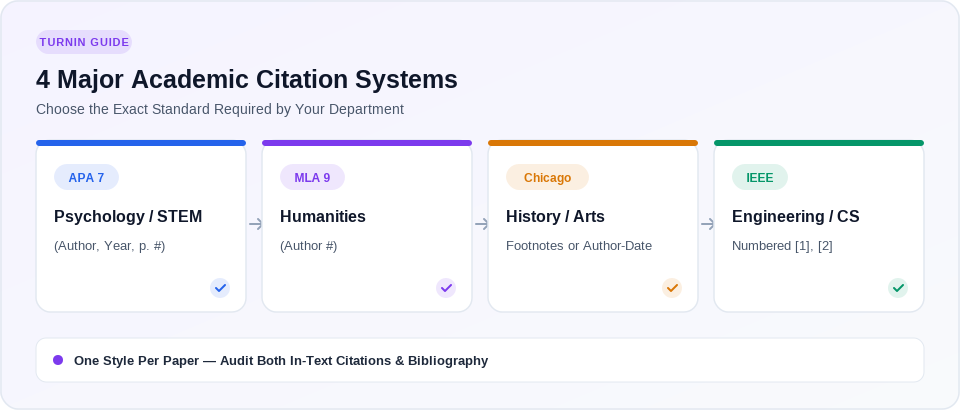
2. Side-by-Side Comparison: Same Journal Paper & Book Across 5 Formats
Compare the exact same two sources formatted across all five major academic styles:
- Journal Paper: Maya Lin and David Okafor (2024), *"Algorithmic Feedback in First-Year Writing Seminars,"* *Journal of Academic Writing*, vol. 18, no. 2, pp. 112–129, DOI
10.1080/00000000.2024.123456. - Book: Elena Rostova (2022), *Designing Quantitative Research*, Oxford University Press (New York).
| Style & Primary Fields | In-Text / Note Format | Journal Article Entry | Book Entry |
|---|---|---|---|
| APA 7 (Psychology, Education, Social Sciences) | (Lin & Okafor, 2024, p. 115) / (Rostova, 2022, p. 42) | Lin, M., & Okafor, D. (2024). Algorithmic feedback in first-year writing seminars. *Journal of Academic Writing*, *18*(2), 112–129. https://doi.org/10.1080/00000000.2024.123456 | Rostova, E. (2022). *Designing quantitative research*. Oxford University Press. |
| MLA 9 (Literature, Languages, Cultural Studies) | (Lin and Okafor 115) / (Rostova 42) | Lin, Maya, and David Okafor. "Algorithmic Feedback in First-Year Writing Seminars." *Journal of Academic Writing*, vol. 18, no. 2, 2024, pp. 112–129, https://doi.org/10.1080/00000000.2024.123456. | Rostova, Elena. *Designing Quantitative Research*. Oxford University Press, 2022. |
| Chicago Notes & Bib (17th) (History, Arts, Humanities) | Footnote: 1. Maya Lin and David Okafor, "Algorithmic Feedback in First-Year Writing Seminars," *Journal of Academic Writing* 18, no. 2 (2024): 115. | Lin, Maya, and David Okafor. "Algorithmic Feedback in First-Year Writing Seminars." *Journal of Academic Writing* 18, no. 2 (2024): 112–129. https://doi.org/10.1080/00000000.2024.123456. | Rostova, Elena. *Designing Quantitative Research*. New York: Oxford University Press, 2022. |
| Chicago Author-Date (Political Science, Anthropology) | (Lin and Okafor 2024, 115) / (Rostova 2022, 42) | Lin, Maya, and David Okafor. 2024. "Algorithmic Feedback in First-Year Writing Seminars." *Journal of Academic Writing* 18 (2): 112–129. https://doi.org/10.1080/00000000.2024.123456. | Rostova, Elena. 2022. *Designing Quantitative Research*. New York: Oxford University Press. |
| IEEE (Engineering, Computer Science, Robotics) | [1] or [2, p. 42] (by order of appearance) | [1] M. Lin and D. Okafor, "Algorithmic feedback in first-year writing seminars," *J. Acad. Writing*, vol. 18, no. 2, pp. 112–129, 2024, doi: 10.1080/00000000.2024.123456. | [2] E. Rostova, *Designing Quantitative Research*. New York, NY, USA: Oxford Univ. Press, 2022. |
3. Discipline Mapping and Style-Switching Traps
Which Style Belongs to Which Discipline?
Always confirm your syllabus or thesis handbook first, then follow standard field conventions:
- APA 7: Psychology, education, nursing, public health, and business.
- MLA 9: English, comparative literature, modern languages, and media studies.
- Chicago Notes & Bibliography: History, art history, musicology, and theology.
- Chicago Author-Date: Anthropology, archaeology, and selected political science journals.
- IEEE: Electrical engineering, computer science, telecommunications, and robotics.
Four Traps That Catch Students Switching Styles
- Sentence Case vs. Title Case: APA 7 uses sentence case (first word, proper nouns, and post-colon word capitalized) for *both* articles and books. MLA 9 and Chicago use Title Case for both. IEEE splits the rule: sentence case for quoted articles, Title Case for italicized books.
- Author Initials and Connectors: APA 7 inverts every author (
Lin, M., & Okafor, D.) with&. MLA and Chicago invert only the first author (Lin, Maya, and David Okafor) withand. IEEE places initials first (M. Lin and D. Okafor) and numbers references by appearance rather than alphabetically. - Where `p.` and `pp.` Appear: APA 7 includes
p./pp.inside in-text citations(2024, p. 115)but omits them in journal ranges (112–129). MLA 9 reverses this: nop.in-text(115), mandatorypp.in Works Cited (pp. 112–129). - DOI Syntax and Publisher Cities: APA 7 and MLA 9 require full
https://doi.org/...URLs and drop publisher cities for modern books. IEEE usesdoi: 10.xxxx/...and keeps city, state/country, and abbreviated publishers (Oxford Univ. Press).

4. A 5-Step Citation Verification Workflow Before Submission
Run this quick pre-submission check to eliminate mismatched punctuation and broken citations:
- Lock the exact edition early: Confirm whether your department requires APA 7 (not 6th), MLA 9, Chicago Notes & Bibliography, Chicago Author-Date, or IEEE before drafting section one.
- Store complete metadata while reading: Save DOIs, volume/issue numbers, and exact page spans in your Turnin Literature Library as you read, rather than chasing missing details before the deadline.
- Generate and audit every reference: Format your bibliography with the Turnin Citation Generator, then check capitalization, italics, and journal abbreviations against the comparison table above.
- Verify 1-to-1 in-text matching: Confirm every
(Author, Year)or[1]in your body text has a corresponding bibliography entry, and delete any uncited background readings. - Polish attribution phrasing and check integrity: Review reporting verbs, quotation marks, and academic phrasing with the Turnin Academic Grammar Checker so borrowed ideas stay clearly attributed. When reviewing pre-submission similarity indicators on Turnin, use them responsibly to improve attribution and authentic paraphrasing—remembering that Turnin is a student preparation aid and your university's official system always prevails.
5. Frequently Asked Questions
Can I use "et al." on the first citation in APA 7 and MLA 9?
Yes. For works with three or more authors, both APA 7 and MLA 9 now use et al. from the very first in-text citation—for example, (Lin et al., 2024) in APA 7 and (Lin et al. 115) in MLA 9. Two-author sources still list both surnames every time.
Does switching citation styles change similarity scores?
Choosing APA 7 over IEEE does not create plagiarism on its own when attribution is accurate. However, missing quotation marks, broken in-text pointers, or omitted references can trigger avoidable overlap flags. Revise responsibly with original synthesis, and note that your university's official system always governs the final evaluation.
How do I cite an article with an electronic locator instead of page numbers?
Many open-access and STEM journals assign an electronic article number (such as e10421 or 110452) instead of page ranges. In APA 7, write Article e10421 after the issue; in IEEE, use Art. no. 110452; in MLA 9, place the locator where pages go and include the full DOI URL.