Paraphrasing Without Plagiarism: 5 Academic Techniques
Learn how to spot patchwriting, preserve essential technical terminology, and apply five structural paraphrasing techniques with real academic examples and proper citations.

TL;DR: Accidental plagiarism usually happens through "patchwriting"—keeping a source's sentence structure while swapping a few words—rather than deliberate copying. True paraphrasing restructures syntax and analytical framing while keeping exact technical terms intact, and every paraphrased idea still requires an accurate citation.
Patchwriting vs. Genuine Paraphrasing: Why Synonym Swapping Fails
Every semester, diligent students walk into university writing centers stunned by a 34% similarity report on a paper they genuinely tried to write in their own words. When we open the draft side by side with the source article, the culprit is almost always patchwriting: keeping the original author's sentence blueprint, clause order, and logic intact while trading individual verbs or adjectives for thesaurus synonyms.
Patchwriting happens when you draft while staring directly at a source paragraph. Even if you change half the vocabulary, similarity algorithms—and experienced instructors—spot the mirrored syntax immediately. Worse, swapping specialized terminology for rough synonyms quietly introduces factual errors. True academic paraphrasing means absorbing the author's point, closing the source, and rebuilding the claim around your paper's specific argument. And one rule never bends: rewording an idea into fresh prose never turns someone else's research into your own—paraphrased ideas always require an in-text citation and bibliography entry.
5 Proven Techniques—and Why Technical Terms Stay Fixed
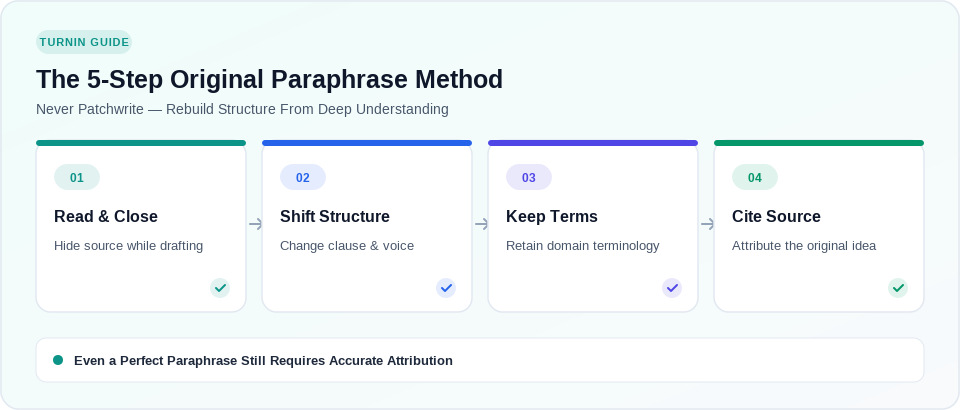
Students often ask whether they should reword discipline-specific terms like *cognitive load*, *insulin resistance*, *carbon sequestration*, or *statistical significance*. The answer is no. In academic prose, technical terms carry precise operational meanings; changing *"working memory"* to *"short-term brain storage"* signals confusion rather than originality. Instead, shift sentence structure, grammatical agency, and analytical emphasis while preserving exact domain terms.
| Technique | What Changes | What Stays Fixed | Best Academic Use Case |
|---|---|---|---|
| 1. Clause Inversion & Emphasis Shift | Moves the dependent clause, result, or limitation to the front | Core variables, dates, and technical terminology | Highlighting findings that directly support your thesis |
| 2. Nominalization / Agency Shift | Converts noun phrases into active verbs (or vice versa) | Causal direction and exact empirical claims | Turning dense methodology prose into concise prose |
| 3. Cause-and-Effect Reframing | Reverses starting point from mechanism to outcome (or reverse) | Underlying relationship and citation attribution | Explaining why an effect occurs in a literature review |
| 4. Multi-Source Synthesis | Combines findings from 2–3 studies into one thematic claim | Distinct contributions credited to each author | Literature reviews where single-study summaries feel repetitive |
| 5. Concept-First Recall | Drafted from brief bullet notes without viewing the source | Specific statistics, thresholds, and domain concepts | Preventing accidental syntax mirroring on complex paragraphs |
3 Worked Academic Examples: Source, Patchwriting, and Real Paraphrase
Here is how those five techniques look in practice across three disciplines—and why patchwriting fails even when most words are altered.
Example 1: Psychology & Education (Clause Inversion + Technical Precision)
- Original Source (Sweller, 2020): *"When instructional materials present redundant verbal and visual explanations simultaneously, learners experience heightened extraneous cognitive load, which impairs schema acquisition."*
- Patchwriting (Fails): *"Whenever teaching resources show repetitive spoken and visual descriptions at the same time, students undergo increased unnecessary cognitive burden, which damages mental framework learning."* (Identical clause skeleton, plus distorted terms like *"cognitive burden"*.)
- Genuine Paraphrase (Passes): *"Schema acquisition suffers when lessons pair overlapping text and visuals simultaneously, because redundant explanations force learners to process extraneous cognitive load (Sweller, 2020)."*
- Why it works: It opens with the educational outcome (Technique 1), preserves *schema acquisition* and *extraneous cognitive load* intact, and credits Sweller clearly.
Example 2: Public Health & Biology (Agency Shift + Cause-and-Effect Reframing)
- Original Source (Lopez et al., 2023): *"Chronic low-grade systemic inflammation driven by gut microbiota dysbiosis has been linked to progressive insulin resistance in adults with metabolic syndrome."*
- Patchwriting (Fails): *"Long-term mild body-wide inflammation caused by intestinal bacteria imbalance has been connected to advancing insulin resistance in grown-ups having metabolic syndrome."* (Mechanical word-for-word substitution.)
- Genuine Paraphrase (Passes): *"In adults diagnosed with metabolic syndrome, imbalances in the gut microbiota can trigger persistent, low-grade systemic inflammation that progressively undermines insulin sensitivity (Lopez et al., 2023)."*
- Why it works: It flips passive voice into an active causal chain (Techniques 2 & 3), anchors the population upfront, and retains *gut microbiota*, *systemic inflammation*, and *metabolic syndrome* accurately.
Example 3: Economics & Policy (Concept-First Recall + Synthesis Framing)
- Original Source (Chen & Patel, 2024): *"Rather than stifling industrial competitiveness, predictable carbon pricing schedules incentivize manufacturing firms to accelerate capital investment in low-emission equipment."*
- Patchwriting (Fails): *"Instead of suppressing factory rivalry, steady carbon cost timelines motivate production companies to speed up money spending on low-pollution machinery."* (Awkward phrasing like *"factory rivalry"* and *"money spending"*.)
- Genuine Paraphrase (Passes): *"Evidence from manufacturing sectors suggests that clear, long-term carbon pricing encourages earlier capital upgrades toward low-emission equipment without eroding industrial competitiveness (Chen & Patel, 2024)."*
- Why it works: Written from concept notes (Technique 5), it reframes the policy takeaway objectively while keeping exact economic terms (*carbon pricing*, *capital upgrades*, *industrial competitiveness*) intact.

Your 5-Step Paraphrase Verification Checklist Before Submission
Before uploading an essay or journal manuscript, run every heavily cited section through this five-step verification routine:
- Draft from conceptual notes, never side-by-side. Jot down three-word cues (*"carbon price -> early capex"*), close the PDF, and write your sentence inside the flow of your own paragraph. If you need structural inspiration for dense academic prose, test variations with Turnin's academic paraphrasing tool and verify that your technical terms remain exact.
- Audit sentence blueprints—not just vocabulary. Place your sentence next to the original. If the subject, main verb, and subordinate clause appear in the exact same order, restructure using clause inversion or agency shifting before moving on.
- Lock down every citation immediately. Never leave placeholders like *(cite later)* in a working draft. Format APA, MLA, Chicago, or IEEE entries as you write using Turnin's academic citation formatter so paraphrased concepts stay visibly linked to their originators.
- Check that your prose sounds human and analytical. Over-engineered rewrites can read stiff or trigger AI-style cadence warnings. Use Turnin's natural academic flow refiner selectively to smooth mechanical transitions while keeping your concrete evidence, dates, and critical voice front and center.
- Run a responsible pre-submission check. Upload your near-final draft for a Turnin pre-submission similarity and AI check to spot lingering three-line overlaps or missing attribution. Remember that Turnin is an independent preparation aid—not an official university Turnitin portal—and your institution's official plagiarism and AI evaluation system always makes the final determination.
Frequently Asked Questions
Do I still need an in-text citation if I rewrite a source completely in my own words?
Yes—always. Citation rules protect intellectual credit for ideas, data, models, and interpretations, not merely exact phrasing. Even a 100% original paraphrase with zero matching words is considered plagiarism if it presents another researcher's finding or argument without attribution.
Will keeping technical terms trigger a high similarity score?
Rarely on its own. Short, unavoidable noun phrases like *metabolic syndrome* or *random forest classifier* may be highlighted as 2–3 word matches, which instructors routinely disregard when overall similarity stays low (typically under 15%–20% excluding references and quotes). Problems arise when surrounding verbs, transitions, and clause structures also match the source.
Can an automated paraphraser make my essay sound robotic or get flagged?
Yes, if used blindly. Generic synonym spinners often replace natural academic collocations with awkward phrases that reduce clarity and resemble synthetic text patterns. Treat paraphrasing tools as structural brainstorming aids, then edit every sentence yourself for precision, logical flow, and accurate citations.