
The conclusion that closes too firmly
An essay can become less honest in its final paragraph. After pages that carefully acknowledge alternatives, the ending suddenly announces a single answer because an ending seems to require one. The reader receives confidence the discussion has not earned. Yet the opposite ending, a general statement that everything is complicated, can be just as unsatisfying. Both forms avoid describing exactly what the writer now knows and does not know.
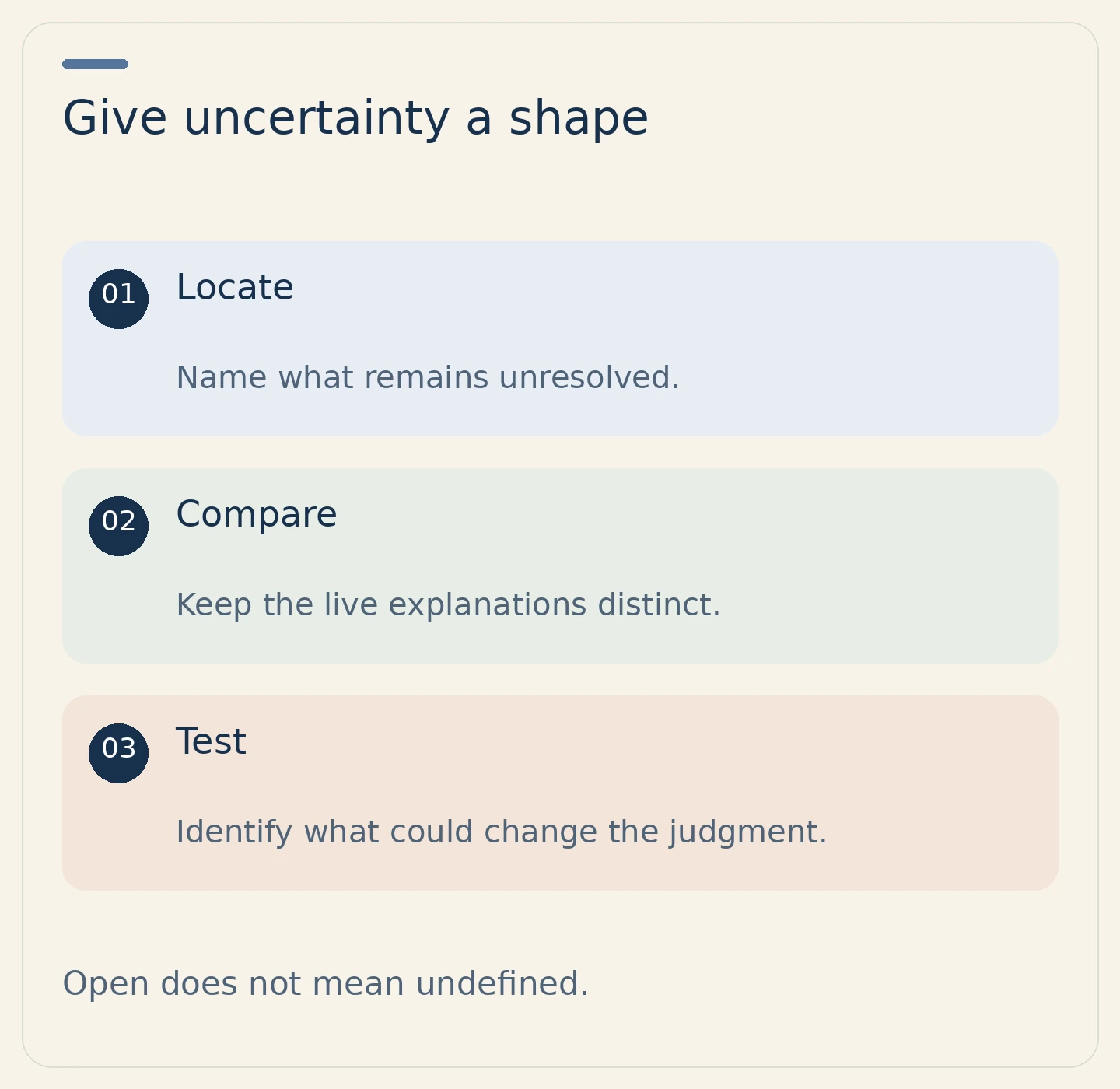
An open question is useful when it has edges. It specifies an uncertainty, identifies the explanations still in play, and makes clear what would help distinguish them. That is different from leaving a blank space where a conclusion belongs. It is a positive account of the boundary reached by the reasoning, including the ground that has already been covered.
Two explanations, one observation
Consider an imagined essay about why a voluntary discussion group has fewer participants than expected. The available material shows that the group meets at an inconvenient hour and that its invitation describes the purpose vaguely. Either feature could matter. If the material does not separate their effects, choosing one as the established explanation would go beyond what the essay can support.
The writer can still say something definite. The evidence does not justify treating low attendance as a lack of interest, because practical access and unclear purpose remain plausible alternatives. That conclusion is narrower than a complete explanation, but it is not empty. It rules out an unwarranted inference while preserving the unresolved question. A careful limit can do real argumentative work.
Name what would make a difference
A small experiment is to write the uncertainty in one sentence, followed by the competing explanations and the material that could shift the judgment. For the imagined group, the writer might need information that distinguishes inability to attend from uncertainty about the event's purpose. Simply collecting more examples of low attendance would not necessarily help. The missing material must bear on the difference between explanations.
This exercise also tests whether the uncertainty is genuine or merely vague. If the writer cannot describe any observation that would alter their view, the difficulty may lie in an undefined claim rather than absent information. If the alternatives require different kinds of material, that too should be visible. Specifying what would matter prevents openness from becoming a comfortable position that nothing could ever disturb.
The distinction can also reveal what further material would not help. Another general statement that the event was unpopular might repeat the outcome without separating its possible causes. More material is valuable only when it can alter the relationship among the explanations still being considered.
A task may still require a decision
Some assignments ask for a recommendation, not simply an account of uncertainty. A writer cannot satisfy that request by declaring the matter unresolved and stopping there. It may be necessary to make a provisional judgment, explain the assumptions behind it, and show how the recommendation would change if those assumptions failed. Uncertainty can qualify a decision without removing the responsibility to decide.
Nor must every possible explanation remain alive. An alternative without support should not receive equal weight merely because it cannot be disproved completely. The point is to preserve explanations that remain credible in relation to the material, not to assemble an unlimited collection of possibilities. Precision includes saying which uncertainties matter to the task and which do not currently deserve more of its limited space.
An ending that leaves the right thing open
The imagined essay might conclude that improving the invitation is a reasonable provisional step because it addresses a visible ambiguity, while making clear that this does not establish why participation is low. The recommendation and the explanation occupy different levels of confidence. Keeping them separate lets the reader assess both rather than accept a practical suggestion as proof of a causal account.
A well-described unanswered question can therefore be a form of intellectual completion. The writer has completed the work that the available material allows, not claimed that the world has supplied a complete answer. The ending offers a reliable map of the stopping point. What remains open is no longer a fog over the whole subject, but a particular door whose significance, and whose current closure, the reader can understand.