
A better-looking week
Imagine a desk with a freshly redesigned weekly plan. The colors are calmer than yesterday's, the work blocks more balanced, and the difficult paragraph has moved to a more promising hour. Nothing is wrong with the schedule in itself. Yet the paragraph remains unopened. Planning has become the activity that feels responsible while postponing the encounter that would reveal what is actually difficult.
It would be unfair to call every revised timetable avoidance. A changed deadline or an unpredictable working week can require real replanning. A plan may also make a crowded life more manageable. The narrower concern is repetition without new information: moving the same task again while learning nothing about the task that might help explain why it keeps moving.
A schedule can allocate time. It cannot determine whether the paragraph lacks a claim, an example, or a reason for existing. Those are questions that become visible only through contact with the material. When the planning surface receives all the attention, a problem of thought is repeatedly treated as a problem of arrangement.
A page with a job
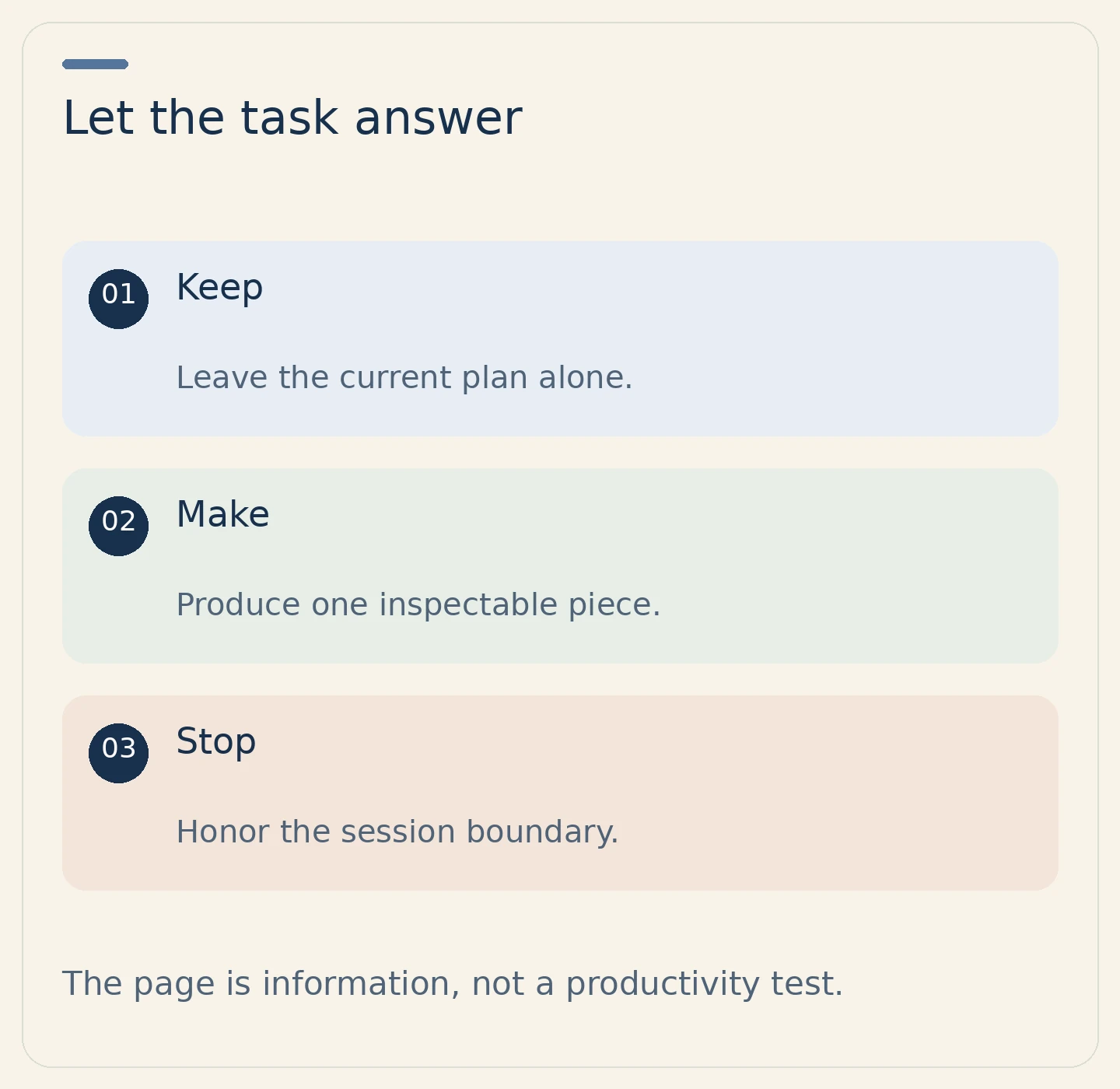
For one session, the imagined writer might keep the existing plan and define a small output: a rough paragraph that explains why the chosen example matters. The output need not be a literal full page. It needs to be something inspectable rather than an instruction to work harder. A few connected sentences can expose a missing assumption that another elaborate calendar would leave hidden.
The session also needs a stopping boundary. Without one, the exercise can become a punishment for earlier delay: now the writer must stay until the entire problem is solved. That demand recreates the size of the task that was being avoided. A bounded encounter asks only for enough contact to learn something, followed by an honest decision about what the next encounter requires.
What counts as a useful result
Suppose the draft paragraph reveals that the example answers a different question from the one in the introduction. This is not the expected output, but it is usable information. The writer can now reconsider the example or the question. The timetable did not fail because it could not predict that discovery. It simply could not substitute for the writing through which the discovery became possible.
Another session may produce little beyond a clearer account of the obstacle. That account needs substance: the claim depends on a comparison not yet made, rather than a vague declaration that writing is hard. The experiment should not rename every unproductive interval progress. Its value is that it creates a visible difference between what was uncertain before and what is uncertain now.
Sometimes contact confirms a practical constraint instead. The task may be too large for the available interval, or the writer may need material that is not at hand. Then replanning is justified by something learned. The distinction is not between planning and doing as enemies. It is between plans repeatedly polished in isolation and plans revised in response to the work they are supposed to support.
A useful stopping boundary also protects the information the session produces. If the writer keeps going until exhaustion, a specific obstacle may blur into a general feeling of failure. Ending while the difficulty can still be named makes the next decision more accurate: the work needs a comparison, not another promise to become a different kind of worker.
Rest is not the rival
A bounded session is not an argument that every spare interval should produce an artifact. Rest, paid work, and care for others are not failures of scheduling. The relevant comparison is between two activities already occupying study time: repeatedly designing a plan and testing one modest piece of the task. Making that distinction keeps advice about starting from turning into an accusation about how someone spends their life.
At the end of the imagined session, the original timetable may still be imperfect. The paragraph may also be rough. But the writer now knows something about the actual essay that the beautiful schedule could not disclose. A plan is most useful when it arranges a meeting with reality. It becomes less useful when its continual improvement provides a comfortable place to wait outside the room.