
After the chairs move
The room has begun to empty. In an imagined seminar, a student understands every term on the final slide but cannot explain how the conclusion follows. Asking now feels awkward: the discussion sounded settled, other people are packing, and the question seems embarrassingly basic. So the student copies the conclusion carefully, as though a clean record might substitute for the missing connection.
This is a particular kind of uncertainty. It is not the absence of all understanding. Several pieces are present, but their relationship remains unclear. Treating that uncertainty as a general failure makes the question harder to ask and less useful when it finally emerges. There is a difference between knowing nothing and knowing exactly where an explanation stops working for you.
Small is not shallow
A broad request to explain the whole topic again may conceal a very narrow difficulty. Perhaps the argument moves from what people prefer to what they are able to do. Perhaps a condition introduced earlier has silently dropped out. Identifying the hinge does not make the question trivial. It makes the question answerable. A short exchange can then address a real gap rather than circle around a shared vocabulary.
Precision also protects what the learner already understands. Starting from zero every time uncertainty appears can weaken confidence in sound work. A useful question might state that the first comparison makes sense, then ask why it supports the final recommendation rather than a weaker one. The speaker is not performing ignorance or expertise. They are drawing a provisional boundary around what they can currently defend.
Leave the attempt attached
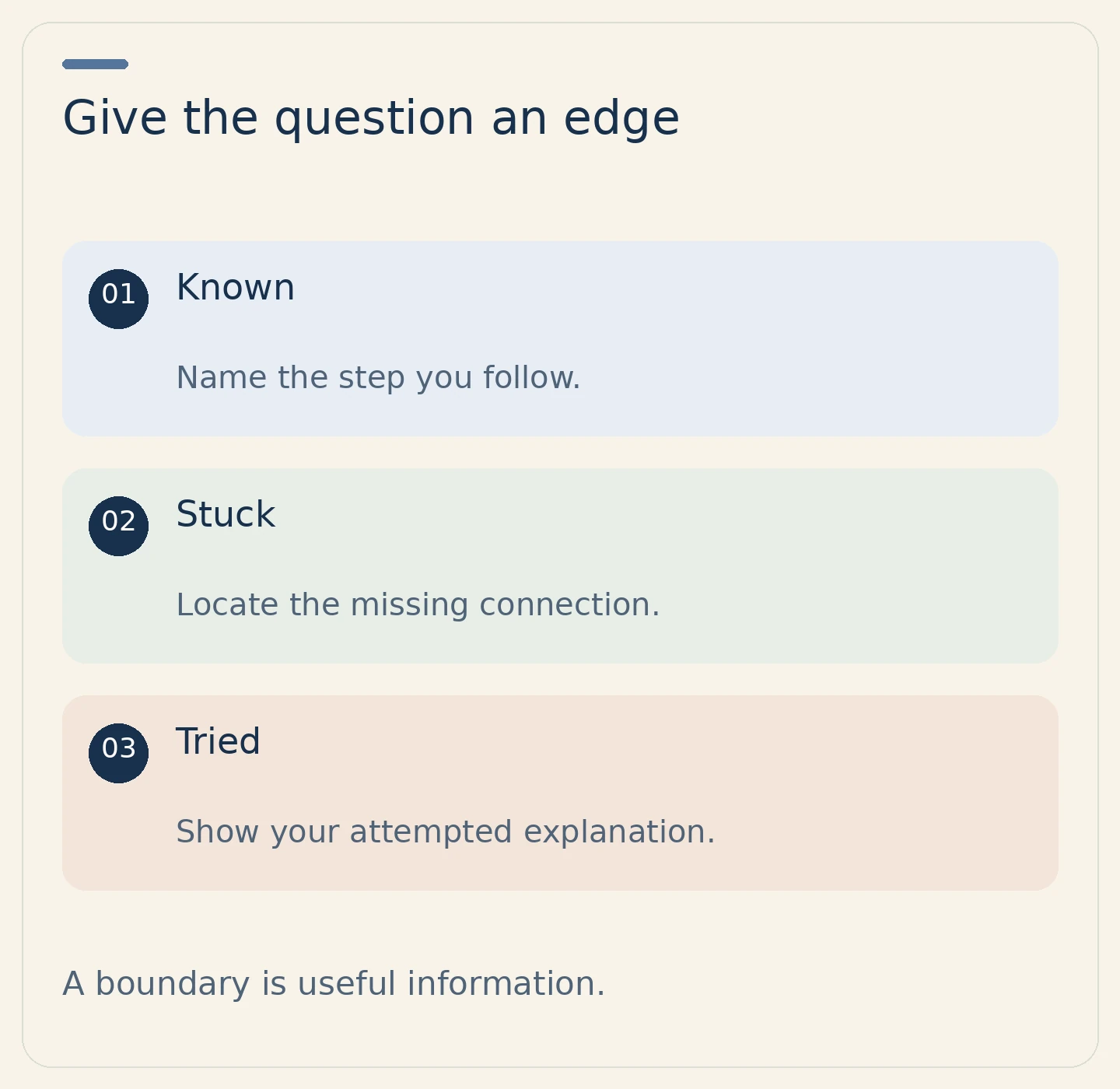
Before approaching someone, the imagined student could write three brief lines: the step that seems clear, the point where the reasoning becomes uncertain, and the explanation already attempted. The last line matters because it lets another person see the actual route taken. Without it, a reply may solve a different difficulty and leave the original one untouched beneath a reassuring answer.
Suppose the attempted explanation depends on an assumption that the seminar never made. Discovering that assumption is useful even if the question receives no immediate answer. The act of preparing to ask has already distinguished the material from the student's addition to it. This is not a requirement to solve everything before seeking help. A rough attempt is enough; its purpose is visibility, not admission to assistance.
An attempted explanation also helps the respondent avoid guessing what level of detail is needed. They can address the mistaken connection rather than repeat the definitions. This makes preparation a form of care for the exchange, not a demand that the learner hide how much help they need.
The setting still matters
Not every room welcomes uncertainty equally. A teacher may be rushing to another commitment; a discussion may have become competitive; someone may reasonably prefer a written question to speaking in front of others. Advice to simply be brave can ignore these conditions. Choosing office hours, a permitted discussion channel, or a concise message is not necessarily avoidance. It can be a thoughtful choice of setting.
Respecting another person's time does not require making the question disappear. It means making its scope clear and accepting that the answer may need to wait. One can ask whether there is time for a specific point, rather than beginning an unlimited conversation. Equally, the answer may be that the issue belongs to a later topic. That response is more informative than pretending the connection has already been understood.
A more accurate ending to the class
The most useful outcome is not always a complete explanation. The student might leave knowing that two claims have been confused, that a missing premise needs checking, or that the conclusion remains debatable. These are different results, and each gives a better account of the lesson than a copied slide that looks complete. Learning can become more precise before it becomes more extensive.
The question left unasked often feels large because it has been carrying a judgment about the person who asks it. Once that judgment is separated from the intellectual task, the question can become small enough to work with. Its modest size is not evidence of a modest mind. It is evidence that an indistinct unease has acquired a shape another person can actually meet.