
The sentence that asks for trust
Some sentences seem important before they become intelligible. Their long nouns and distant verbs suggest that understanding must be earned through repeated rereading. Sometimes it must. A genuinely unfamiliar idea can require sustained attention. But difficulty can also come from an avoidable arrangement of language. The fact that a sentence takes effort to read does not tell us what kind of effort it deserves.
This distinction matters because readers can mistake confusion for evidence of their own inadequacy. Instead of asking whether the explanation works, they assume that a more capable reader would understand it immediately. Writers face the reverse temptation: if direct language sounds less impressive, they may conceal an uncertain relationship inside an elaborate phrase. Neither habit brings the idea into better focus.
Put someone back into the sentence
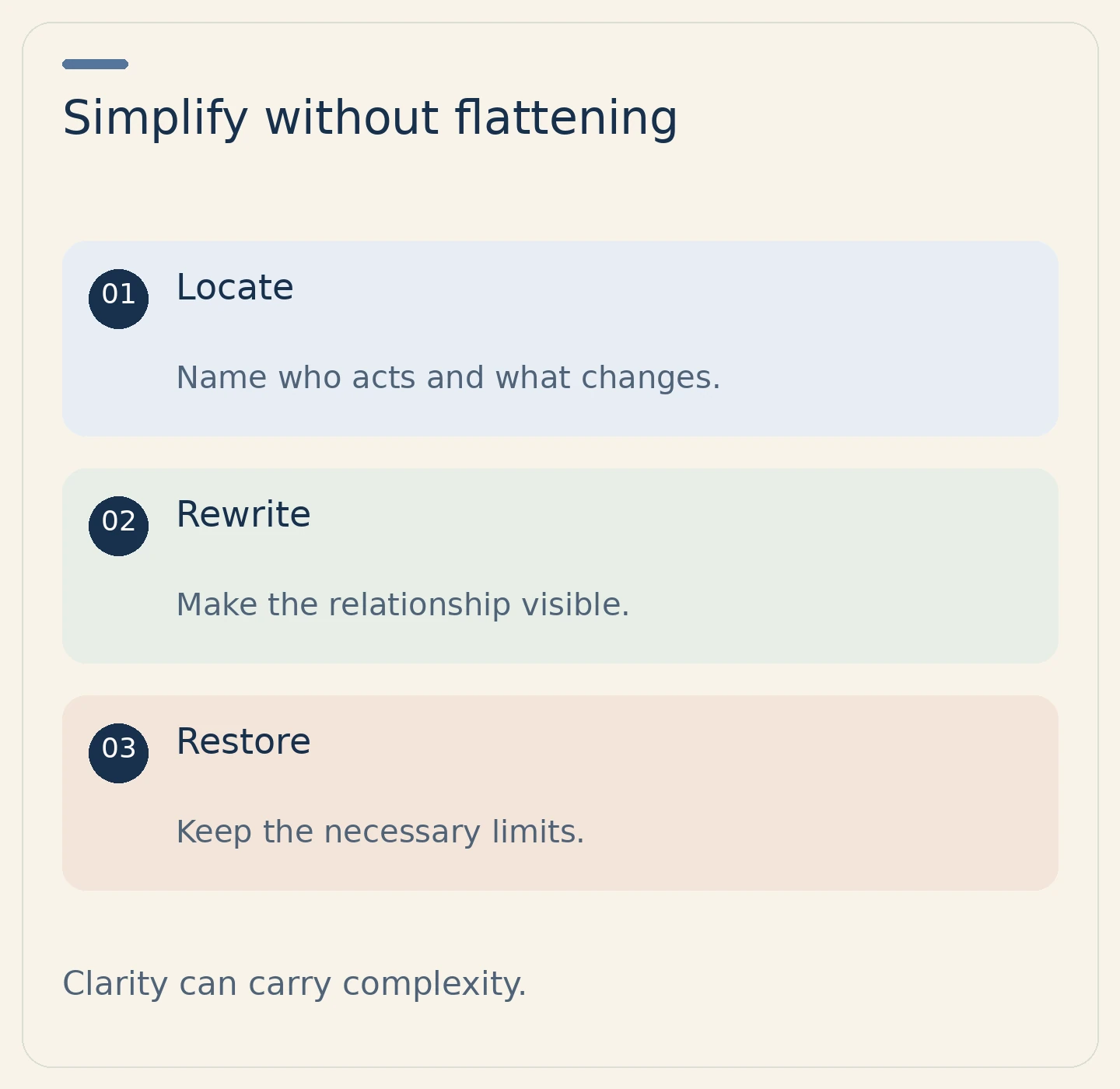
Consider this invented wording: the implementation of spatial allocation adjustments facilitates the optimization of collective utilization. It has the outline of an explanation without giving a reader much to picture. A possible revision is that staff move the tables so more groups can use the room. Now someone acts, something changes, and the intended benefit can be questioned rather than merely accepted.
The revision is not automatically equivalent. The original might refer to changes beyond tables, or to a formal meaning of optimization. If so, those details need to be specified rather than assumed. The exercise exposes an obligation on both versions: what exactly is being changed, by whom, and according to which standard? The shorter sentence is useful because it makes missing information easier to notice.
Keep what resists simplification
A small experiment is to rewrite one difficult sentence with a visible actor and a direct verb. Then place the two versions together and identify each difference in meaning. If the rewrite has turned a tentative possibility into a certainty, restore the uncertainty. If it has erased the circumstances in which the claim holds, restore those circumstances. Ease of reading is not a license to make a larger claim.
This second movement prevents clarity from becoming a cosmetic preference. A sentence can be smooth and wrong. It can be memorable because it omits precisely the exception that matters. The goal is not to produce the fewest words, but to remove the difficulty that contributes nothing while preserving the difficulty that belongs to the subject. Sometimes that leaves a longer sentence with a more legible structure.
This can also reveal that the writer does not yet know what the original sentence means. In that case, asking for clarification is more honest than replacing obscurity with a confident interpretation assembled from familiar words.
Technical language can be a kindness
Specialist terms are not inherently evasive. A well-defined term can name a distinction that ordinary language repeatedly blurs. Among readers who share that definition, replacing it with a loose everyday expression may make the argument less precise and more tiring. The relevant question is not whether a word is common, but whether its role and meaning are available to the intended reader.
An introductory explanation may therefore need both the term and a concrete account of its use. A specialist discussion may need only the term. Neither audience should be treated as the universal reader. What feels clear depends partly on what the reader already knows, and an honest writer can acknowledge that dependence without using it as an excuse for unnecessary opacity or expecting every passage to explain an entire discipline.
Understanding without the performance
In the imagined room example, the clarified sentence might eventually say that staff rearrange tables to accommodate more small groups, provided that wheelchair access remains clear. This version is more specific than either the grand original or the first simplification. It names a purpose and a limit that can coexist. The writing has become easier to follow without making the practical decision easier than it really is.
That is a different kind of intellectual confidence from sounding difficult. It allows the reader to see where the claim could fail, which condition matters, and what remains unsettled. Depth does not require the concealment of those joints. Often the more demanding thought is the one expressed clearly enough that another person can examine it, disagree with it, and discover exactly what the disagreement concerns.