
An AI-use statement should explain what actually happened in your assignment. It should not exaggerate independence, hide substantial assistance or imply that disclosure makes prohibited use acceptable. Start with the course rules, then describe the tool’s role precisely enough for the reader to understand its contribution. No single statement is accepted by every instructor or institution.
Check permission before choosing disclosure wording
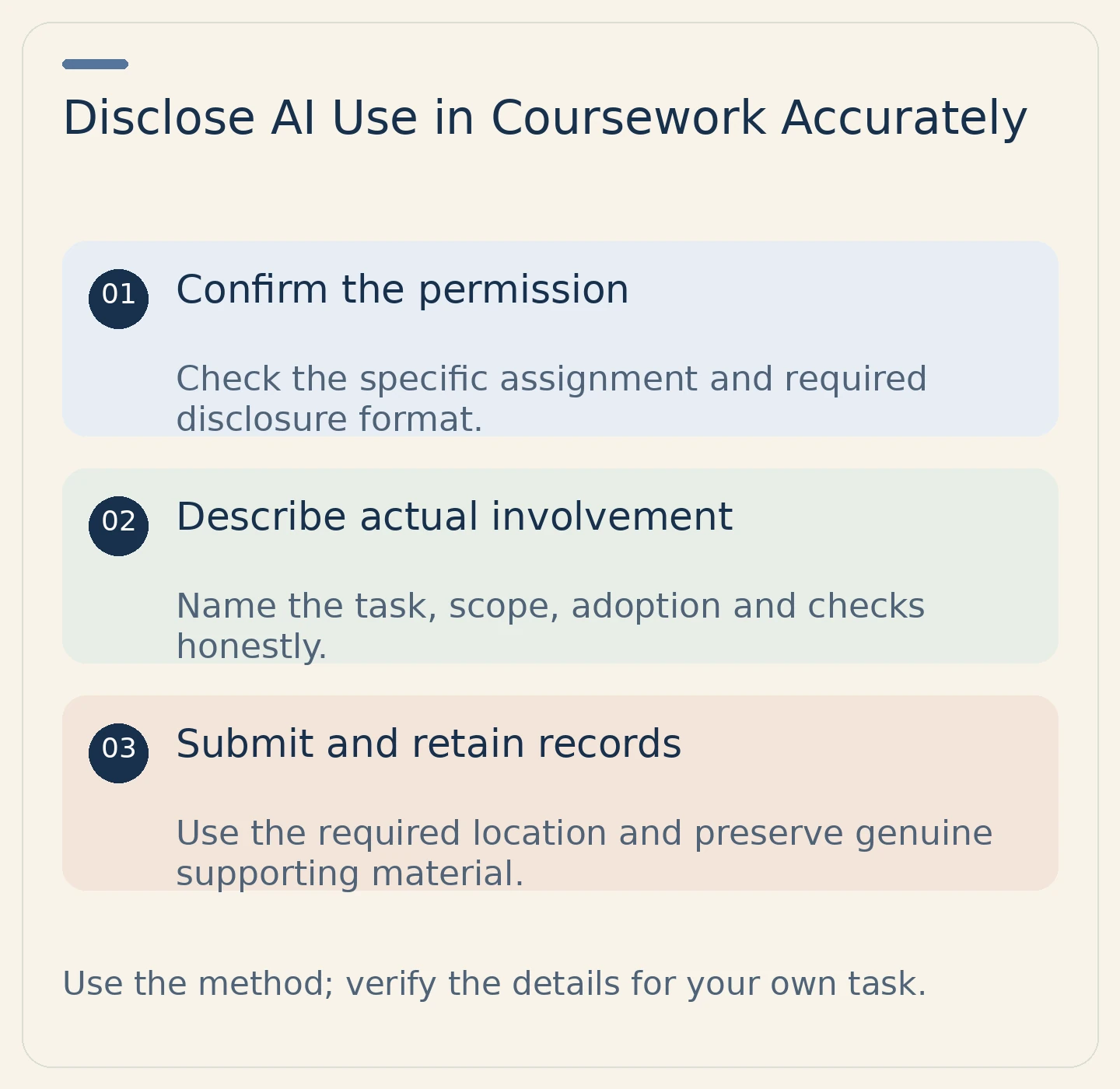
Read the current assignment, syllabus and applicable institutional guidance. Identify which activities are allowed, restricted or prohibited, and whether a declaration or supporting record is required. Permission for grammar feedback may not include translation, outline generation or substantive rewriting. Permission on one assignment does not carry automatically to the next.
If the rules are unclear, ask about a concrete activity rather than “Is AI allowed?” For example, explain that you want suggestions about sentence clarity without replacing your analysis. Keep the answer with the assignment records. Do not interpret silence or a friend’s practice as permission.
Reconstruct actual use before writing the statement
Review your own saved prompts, outputs, notes and drafts. Record the tool name, date or period of use, the stage of work, what you asked for and what you retained. Do not create a false history if records are incomplete; state what you can establish and ask what additional explanation is needed.
Distinguish activities by their actual influence, not a reassuring label. “Language help” can mean identifying a spelling error or rewriting several paragraphs. “Brainstorming” may mean discussing possible questions or supplying the argument eventually submitted. Describe the scope honestly.
| Actual activity | Useful disclosure detail | Check before submitting |
|---|---|---|
| Exploring possible topics | What the tool suggested and what you selected | Was this kind of idea support permitted? |
| Translation or concept explanation | Which material was involved and how meaning was checked | Does the policy allow this use? |
| Language suggestions | Sections affected and changes accepted | Did any edit alter claims or citations? |
| Substantive content generation | What content or structure originated with the tool | Does this exceed the task’s permission? |
Use a specific structure, not a universal formula
A useful drafting structure is: tool and date; purpose and stage; scope of adoption; checks actually performed. Add prompts, outputs or locations only when required or relevant, and follow privacy restrictions before sharing records. The MLA’s guidance distinguishes acknowledgment of substantive AI involvement from a citation to a particular output. That distinction is useful, but the course still determines the required format and location.
The following statements are illustrative structures, not declarations about your work and not universally approved text. Replace every detail with the truth; do not claim checks you did not perform.
- Idea exploration: “I used [tool, date] to discuss possible approaches to [task]. I selected [approach] and developed the submitted argument from [actual materials]. The output’s role was [specific scope].”
- Language suggestions: “After drafting [sections], I used [tool, date] for [specific language task]. I accepted [scope of suggestions] and checked [meaning, terminology or citations actually reviewed].”
- Translation support: “I used [tool, date] to assist with translating [material]. I compared [actual portions] with the original and corrected [relevant issues]. This use is reported under [applicable course instruction].”
If you used substantive generated content, do not choose a narrower language-only example to make the account sound acceptable. Describe that use and seek guidance if it falls outside the permission.
Keep disclosure separate from evidence citations
A tool-use statement does not verify the facts in the paper. Open and read the actual sources behind factual claims, confirm that they support the wording and cite them in the required style. Verify quotations, real locators and reference details. A generated reference that looks plausible is unfinished until source identity and support are established.
Review accepted suggestions for changes to uncertainty, cause and effect, source ownership and the conclusion. You remain responsible for the final argument. Do not claim the tool “only corrected grammar” if it also supplied analysis or reorganized the reasoning.
Submit the statement where the task requires it
Use an institutional template if one is provided. Otherwise ask where the statement belongs rather than assuming a cover page, acknowledgment, appendix or portal comment is interchangeable. Confirm any requirement to attach records and avoid uploading restricted data to an unapproved service.
If reporting is available, keep its role limited. Turnitin’s official AI guide says the indicator can be wrong and should not be the sole basis for adverse action. A favorable result does not waive disclosure, and a concerning result does not establish a breach by itself.
Before upload, check permission, statement accuracy, source support and the final file. Retain genuine drafts, required records and the submission confirmation. If you discover out-of-scope use, consult the instructor honestly; a last-minute statement is not a way to retroactively authorize it.
Related practical guides
For a separate evidence check, use the citation readiness guide; for the final handoff, use the pre-submission checklist. These are supplementary resources, not your institution’s submission system or policy.
Sources and scope
Further reading: MLA: Beyond Citation: Describing AI Use in Your Work; University of Toronto: How Not to Plagiarize; Turnitin: Using the AI Writing Report. Institutional examples apply to their own settings; follow the requirements governing your work.