
The argument with its middle missing
The writer has watched the reasoning develop through several drafts. The reader receives only the last one. That unequal access can produce a peculiar kind of omission: a connection feels so established to the writer that it disappears from the page. The final version retains the observation and the conclusion, while the premise that makes them belong together survives only in memory.
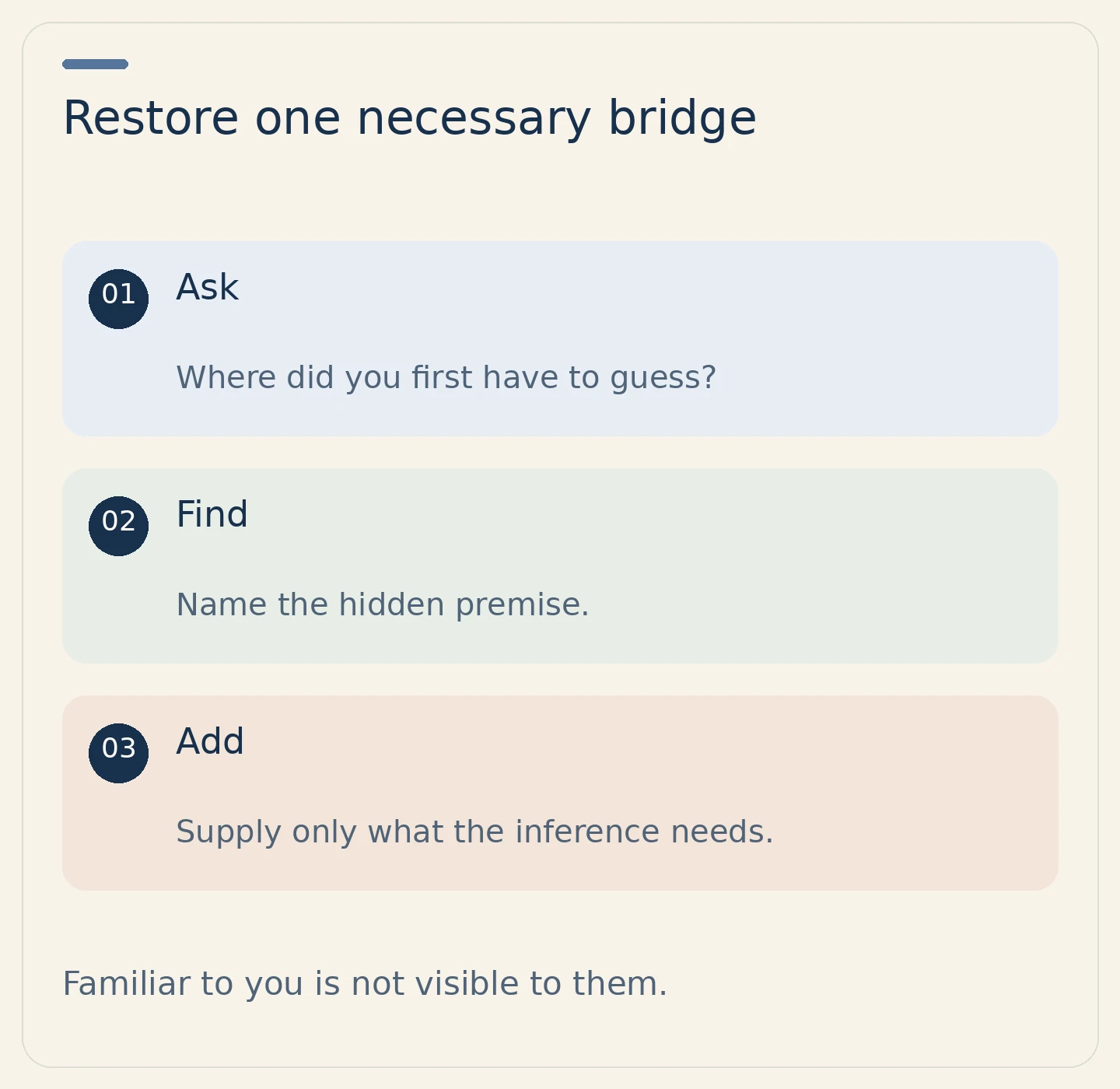
This is not necessarily careless writing. Familiarity can make an unspoken step feel present. Repeated revision may even remove the sentence that once supplied it because the sentence begins to look obvious. The problem becomes visible only when the page is encountered without the discarded drafts, earlier conversations, and private explanations that the writer still carries into every rereading.
An imagined bench at the edge
Suppose an imagined essay observes that people gather at the edge of a public square and concludes that the square needs more places to sit. The writer remembers thinking through the layout: most existing seats are far from the shade, while the gathering point is shaded. But that relationship has vanished from the final paragraph. On the page, standing at the edge seems to lead directly to a seating recommendation.
A reader has reason to hesitate. People could gather there for conversation, proximity to an entrance, or many other purposes. The hidden premise about usable shaded seating would not settle every alternative, but it would explain why the observation bears on the recommendation. Without it, the conclusion asks the reader to supply an interpretation that may never occur to them, or may strike them as unjustified.
Ask for the first guess
A small experiment is to give a short passage to a willing reader and ask where they first had to guess what connected one sentence to the next. This is more focused than asking whether the essay is clear. A general response may produce comments about style, vocabulary, or preference. The first guess locates an actual point at which the reader began doing work the draft may have needed to do.
The writer can then name the missing premise in a separate sentence before deciding how to integrate it. In the square example, the sentence might explain the relationship between the gathering point, shade, and existing seating. Naming it separately makes it possible to ask a harder question: is this premise supported, or has it merely been familiar? A bridge must be defensible, not only helpful.
Do not rebuild every discarded road
Restoring a premise does not require narrating the entire drafting process. The reader needs the connection relevant to the present argument, not every alternative the writer considered on the way. Too much reconstruction can bury the very step it is meant to clarify. The useful addition is often local: one condition, one distinction, or one explanation of why an observation matters to this particular judgment.
Readers also bring knowledge of their own. A specialist audience may not need a premise that an introductory audience requires. The first reader's confusion therefore deserves interpretation rather than automatic obedience. Yet audience knowledge should be assessed realistically, not invoked whenever an explanation feels inconvenient. The question is what this reader can reasonably be expected to bring, not what the writer wishes everyone already knew.
The visible route is a different object
After the imagined paragraph gains its missing relationship, the reader can disagree more precisely. They might accept that shade matters while questioning whether seating is the best response. That is progress in clarity even if it does not produce agreement. The argument now offers a route that can be examined instead of leaving the reader to invent one and then judge their own invention.
A finished draft is not a transparent container for everything its writer has learned. It is a deliberately limited path through that learning. Recognizing the limit changes the purpose of a bridge sentence. It is not there because the reader is slow or because the writer must explain everything. It is there because the writer's memory is not part of the document, and the necessary reasoning has to travel without it.