
A page ready to be admired
Picture an imagined notebook with balanced headings, consistent colors, and definitions copied without a stray mark. Beside it sits a rough page showing two boxes and an arrow with a question mark. The first page looks finished. The second shows a difficulty: the writer does not know why one idea is supposed to lead to the other. Appearance alone cannot tell us which page is doing more useful work.
The contrast is not a contest between tidy and untidy people. Order can make material easier to find and relationships easier to inspect. Some readers genuinely need a clear visual structure to work comfortably. The issue is what the structure reveals. A page can organize uncertainty, or it can cover uncertainty with a convincing image of completion.
Copying a definition gives the hand a clear task. Understanding a definition can be less orderly: a familiar word behaves differently, an exception interrupts the example, or a question has no immediate answer. When formatting becomes the next automatic step, the writer may spend the available attention improving the record before finding out what the record means. The page grows more presentable while the conceptual difficulty stays untouched.
That difficulty can be hard to admit because the source sentence is already there. If the definition has been copied accurately, what else should be needed? Often the missing thing is a relationship: why this case counts and another does not, or how a distinction changes an interpretation. Accurate transcription preserves material for later thought. It does not remove the need for that thought.
One line before the redesign
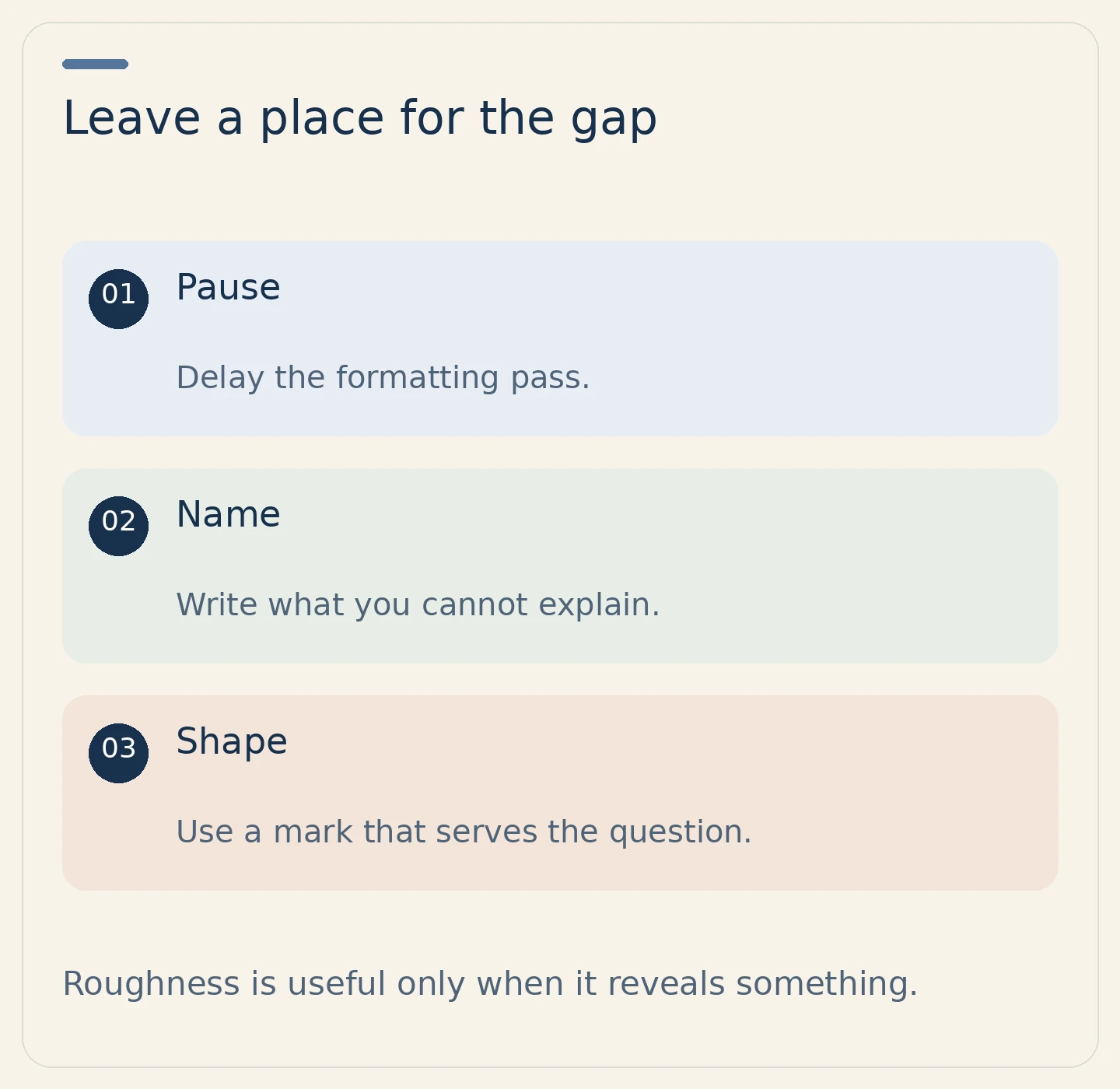
A small experiment is to write one sentence before reorganizing the page: the part I still cannot explain is this. The sentence must name something more specific than the whole topic. Perhaps the writer understands both boxes in the diagram but cannot explain the arrow. Perhaps the example appears to satisfy two categories that the definition presents as separate. The line gives the next study action a reason.
The writer can then choose a form that suits the difficulty. A comparison might need a rough table. A sequence might need arrows. A troublesome boundary might need a case placed between two labels. None of these forms is automatically better because it looks spontaneous. Their value lies in what they expose and whether the reader can return to the page and recognize the question it was built to hold.
Order can still be care
Rejecting beautiful notes altogether would create another performance. Deliberate messiness can be just as distracting as decorative precision if it becomes proof of seriousness. An illegible page may conceal a gap as effectively as an immaculate one. What matters is not the absence of care but its direction. Does the time spent on the page make the material more usable, or mainly make the page look like successful studying?
The answer can change with the task. Notes for a presentation need a different degree of readability from private scratch work. Notes shared with someone else require enough structure to be understood without the writer's memory beside them. Even a private page may benefit from later cleanup. The distinction is between formatting that answers a use and formatting that delays discovering what use the notes must serve.
The unfinished mark that earns its place
In the imagined notebook, the question mark beside the arrow might remain after the rest of the page has been organized. It is not a blemish awaiting removal. It records a precise boundary of understanding. When the writer later finds the missing explanation, a short addition can show what changed. The page becomes a record of thought in motion rather than a display of material successfully collected.
A useful notebook therefore does not need to look permanently unfinished. It needs to permit unfinished understanding to be visible. That permission changes the meaning of care: the writer is no longer caring only for the appearance of the record, but for the honesty of the relationship between the record and what they can actually explain. Sometimes the most valuable mark is the one that prevents a page from looking complete too soon.